Books
-
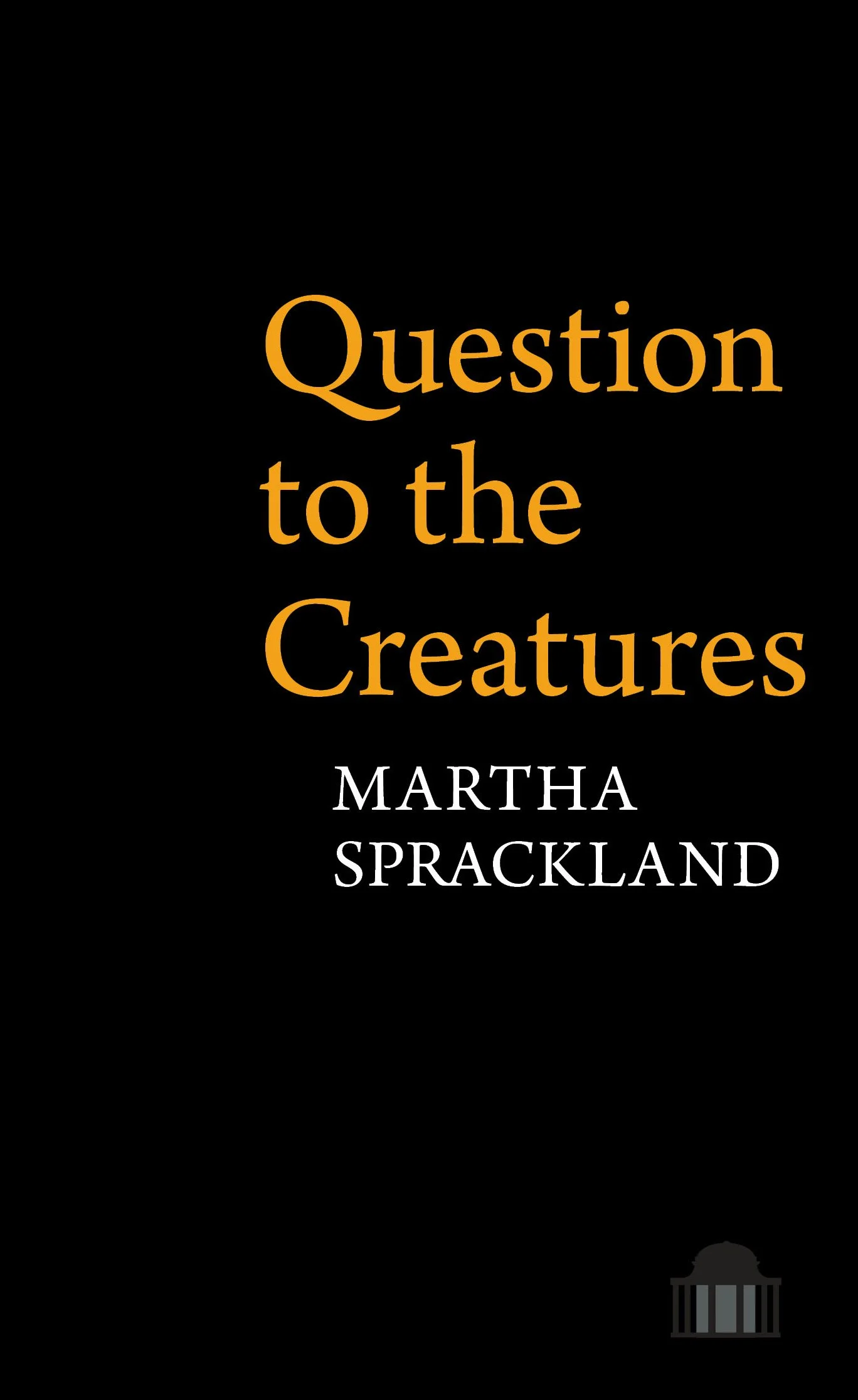
Question to the Creatures
April 2027
Question to the Creatures interrogates confinement and faith, darkness and light, speech, memory and translation. It takes bearings from the work of the Spanish mystic John of the Cross, whose dark night of the soul surrounds the poet-translator in the small hours of new motherhood. When light does break into the darkness, it’s ambiguous: the intoxicating, trickster LEDs that muddle the navigation systems of moths; the ‘standby lights’ of a taxidermist’s eyes; the orange glow of wildfires encroaching on the places of memory. Things are unearthed, turned to the flickering light, and reckoned with: the teeming world of microbial life (‘a million citizen animalcules on hustling commute / illegible to the eye’s bare bulb’), creaturely consciousness, and our responsibility towards those we love, those we lose, and those we never come to meet. Above all, these poems attend to unknowing – Keats’s negative capability, or the ‘hiddenness’ of the mystics – that prefers questions over answers. Full of curiosity, attention and doubt, illuminated by moonlight, torchlight, candle-glow and blazing fire, Question to the Creatures is a formidable second collection.
-
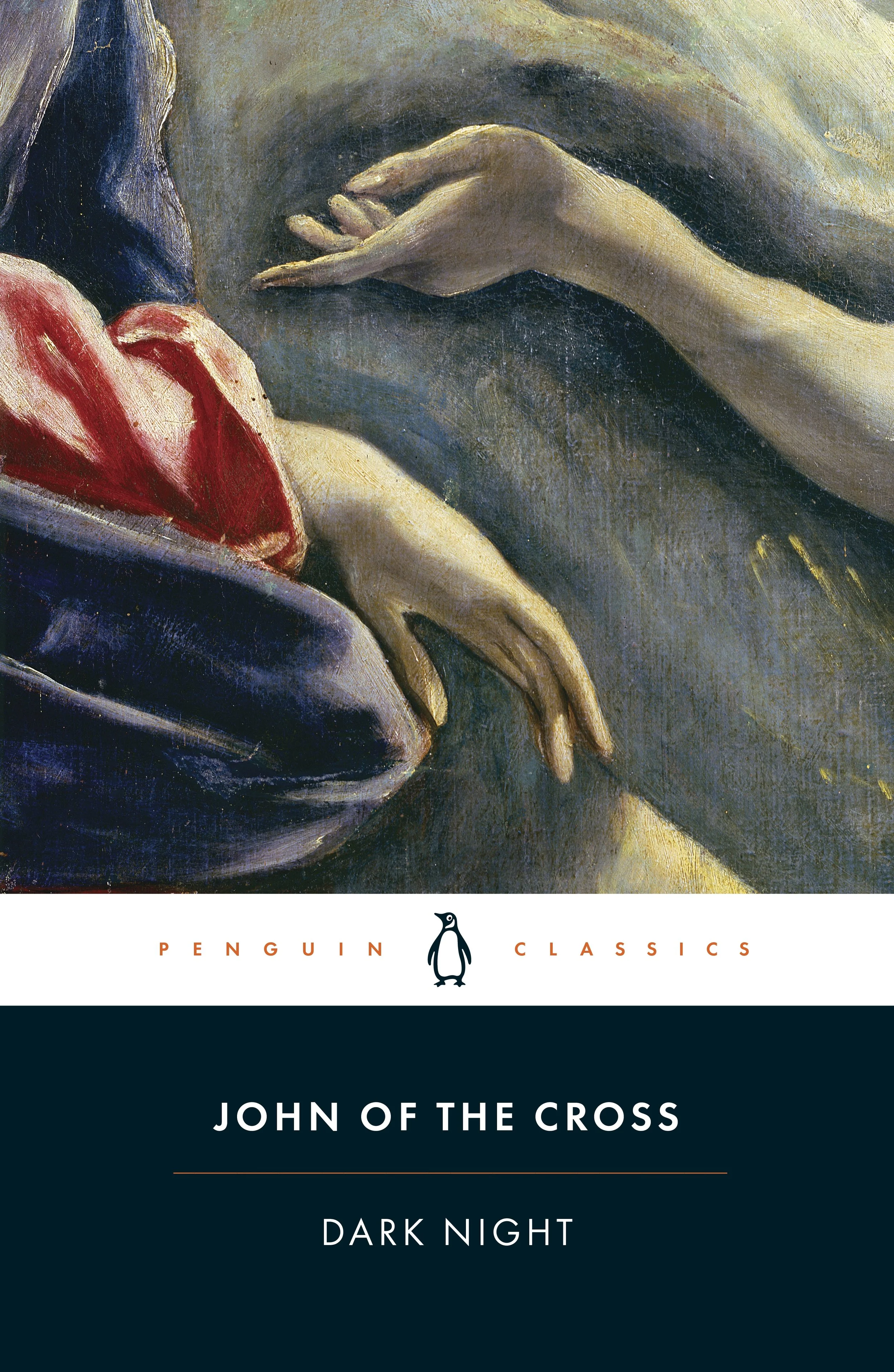
Dark Night: Poems and Selected Prose of John of the Cross
Poetry Book Society Translation Choice
The poetry of the sixteenth-century Spanish mystic, John of the Cross, has inspired and consoled for hundreds of years, influencing writers from James Joyce to Seamus Heaney, Geoffrey Hill to T.S. Eliot and Mary Oppen. This new edition of his essential works, in a sensitive and luminous translation by Martha Sprackland, gathers John of the Cross’s complete poems and a selection of his prose, including from his extended commentary on the poem ‘Dark Night’. In his immediate, sensual writing, we see a soul searching for meaning and union with the divine: both meek and bold, deserving and undeserving, oscillating between light and dark, soaring and falling, desperation and salvation. Dark Night gives us a picture of faith at once confronting and inspiriting, and of the power of words as a means of spiritual transcendence.
Translated by Martha Sprackland, with an introduction by Colin Thompson.‘Sprackland’s new translation of the poetry and meditative prose of the 16th-century mystic John of the Cross is both provocative and timely . . . the works themselves retain all the strangeness and burn that attracted TS Eliot and Salvador Dalí, Thomas Merton and Pope John Paul II.’ – Fiona Sampson, Guardian
‘Sprackland's ear is particularly alive to movement and music ... the result is a St John of the Cross who feels neither embalmed nor modernised, but newly legible. This translation doesn't simply carry the poems across languages; it reanimates them.’ – Leo Boix, PBS
-
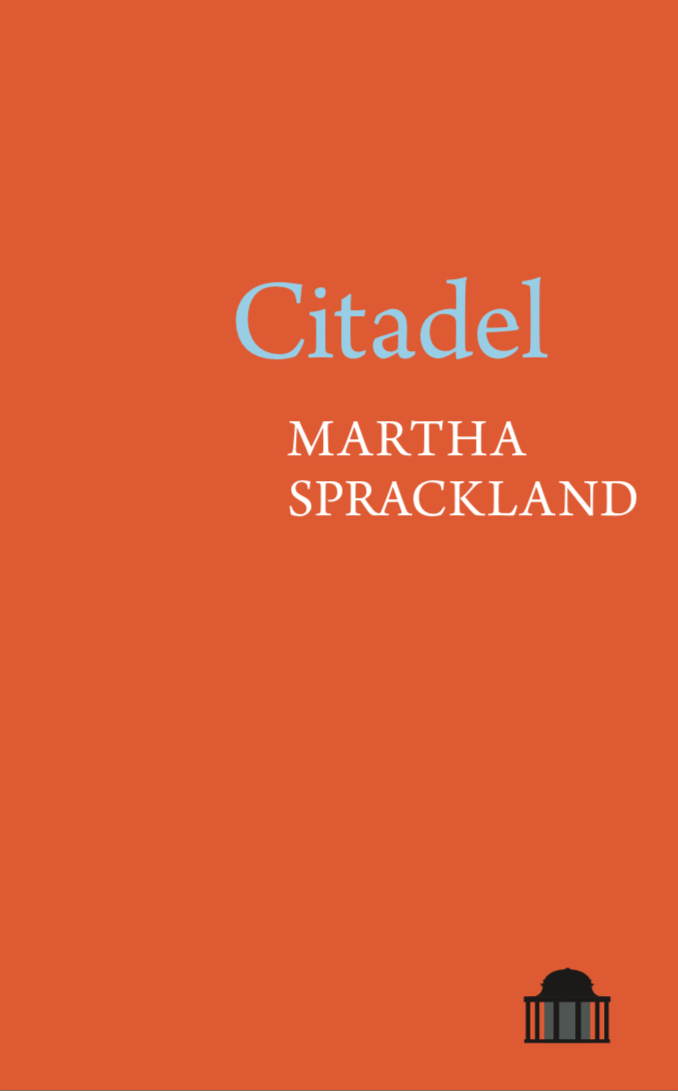
Citadel
Shortlisted for the John Pollard International Poetry Prize, the Forward Prize for Best First Collection, and the Costa Poetry Award
Juana of Castile (commonly referred to as Juana la Loca – Joanna the Mad) was a sixteenth-century Queen of Spain, daughter of the instigators of the Inquisition. Conspired against, betrayed, imprisoned and usurped by her father, husband and son in turn, she lived much of her life confined at Tordesillas, and left almost nothing by way of a written record. The poems in Citadel are written by a composite ‘I’ – part Reformation-era monarch, part twenty-first century poet – brought together by a rupture in time as the result of ambiguous, traumatic events in the lives of two women separated by almost five hundred years. Across the distance between central Spain and the northwest coast of England these powerful, unsettling poems echo and double back, threading together the remembered places of childhood, the touchstones of pain, and the dreamscapes of an anxious, interior world. Symbolic objects – the cord, the telephone, eggs, a flashing blue light – make obsessive return, communication becoming increasingly difficult as the storm moves in over the sea. Citadel is a daring and luminous debut.
'So much fire comes to life in snapshots on these pages ... The images are electrifying. Something marvellous occurs: a domestic scene becomes “a blow to the head / enough to knock the earth from its orbit.” I love this book.' – Ilya Kaminsky
'Martha Sprackland's poems are virtuosic in their timing, texture, and detailed evocation. From poems of the hospital to poems of the shore, this is a fierce and fresh debut that rings with courage and intelligence. Citadel will seize you by the heart and lead you into deep and resonant territories, and when you return you will find yourself changed, strange to yourself, and wondrously enriched.' – Fiona Benson
'a spellbinding, time-travelling debut filled with imagination and mystery.' The Costa Award judges 2020
-
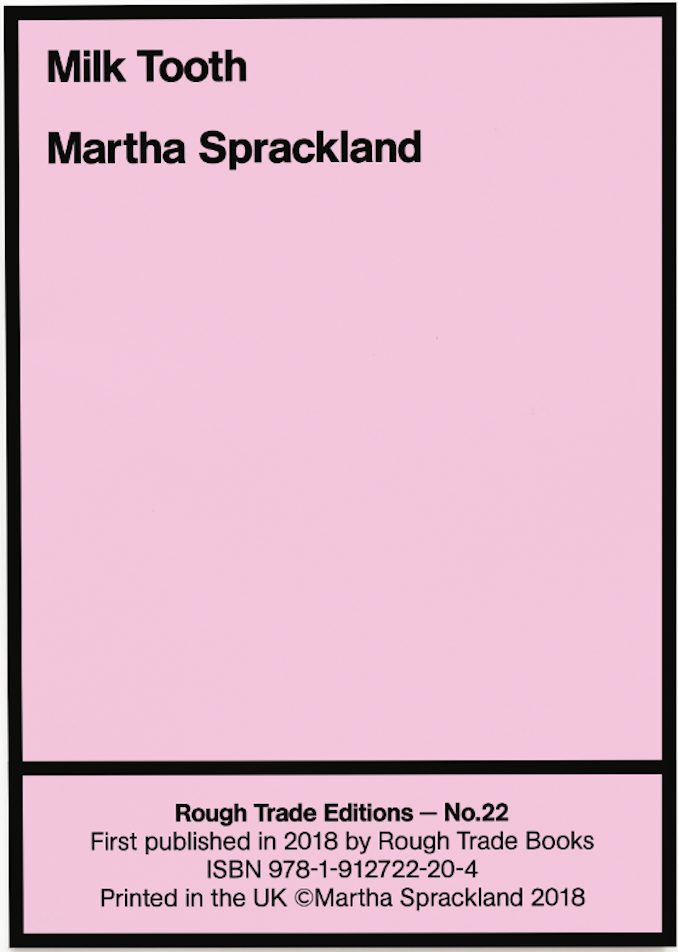
Milk Tooth
Shortlisted for the Michael Marks Award
Things are not always what they seem in these poems of trauma and transformation. Reflections and shape-shifters move through them: a child’s balloon like a fish with a hook in its mouth, a raven disturbingly alive and dead at the same time. Pain is tracked to a bad tooth, but the source is uncertain, the memory unstable and changeable; the picture 'splinters into refracted light'. Remembering, refusing and reimagining create mirrors, doubles and oppositions that tangle the thread, rejecting the simple, single way back.
'Sprackland’s words pierce through the mundanity of the everyday, creating intense emotional landscapes [...] With Milk Tooth, Sprackland continues to establish herself as one of Britain’s finest young poets.' – Robert Greer, London Magazine
'in that Plathian control, that cool presentation of event, vibrant, clustering images take hold and push through intimacy and address . . . Sprackland’s lyric voice is elastic, commodious . . . it bears evidence of its soldered edges, the violence of experience, an ethos of resistance delivered in crisp-cut lines whose intimations of gendered solidarity sting.' – Maria Sledmere, Poetry School
-
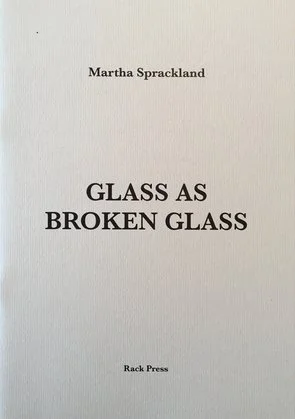
Glass As Broken Glass
Longlisted for a Sabotage Award
London Review Bookshop Spring Picks"[With] formal acuity Martha Sprackland's 'Domestic' characterizes a broken relationship as helplessly frozen syntax teetering on that very word – as – everything that's just happened in a nameless quarrel 'as' something faraway, free of it, clear of it, like smoke or sky. Numbness of spent emotion, wonderfully anatomized: 'Glass as broken glass.'" – Glyn Maxwell
"Sprackland refreshes the domestic and mundane in poems which are outwardly calm, but lit from within to reveal unusual visionary angles." – Eric Gregory Award judges 2014
'A formidable technician.' – Ian Pople, Manchester Review
'A poet of considerable creative powers… with genuine talent and insight.' – Graham Hardie, London Grip
'[A] commanding teller of the strange stories of others . . . Sprackland's best poems have the power of an irresistible tide.' – Alison Brackenbury, PN Review
'Sprackland forces a wonderful fascination upon her readers.' – Edwina Attlee, Poetry Review
'This debut pamphlet refuses to provide easy answers. It packs a lot into so little space.' – D. A. Prince, New Walk
'Intriguing and provocative.' – Elizabeth Rimmer, Sabotage Reviews